Women's Wellness Review
8 Reasons Why Menopausal Women's Feet Don't Respond To Any Moisturizer (And The 60-Second Shower Fix That Actually Works)
8 Reasons Why Menopausal Women's Feet Don't Respond To Any Moisturizer (And The 60-Second Shower Fix That Actually Works)
August 22nd, 2026 at 10:43 am EST
If you've gone through menopause and your feet are still rough, cracked, and peeling despite trying every cream, peel, and prescription on the market, you're not doing anything wrong. You've been treating the wrong problem.
Here are 8 reasons why nothing has worked, and what thousands of women over 45 are switching to instead.
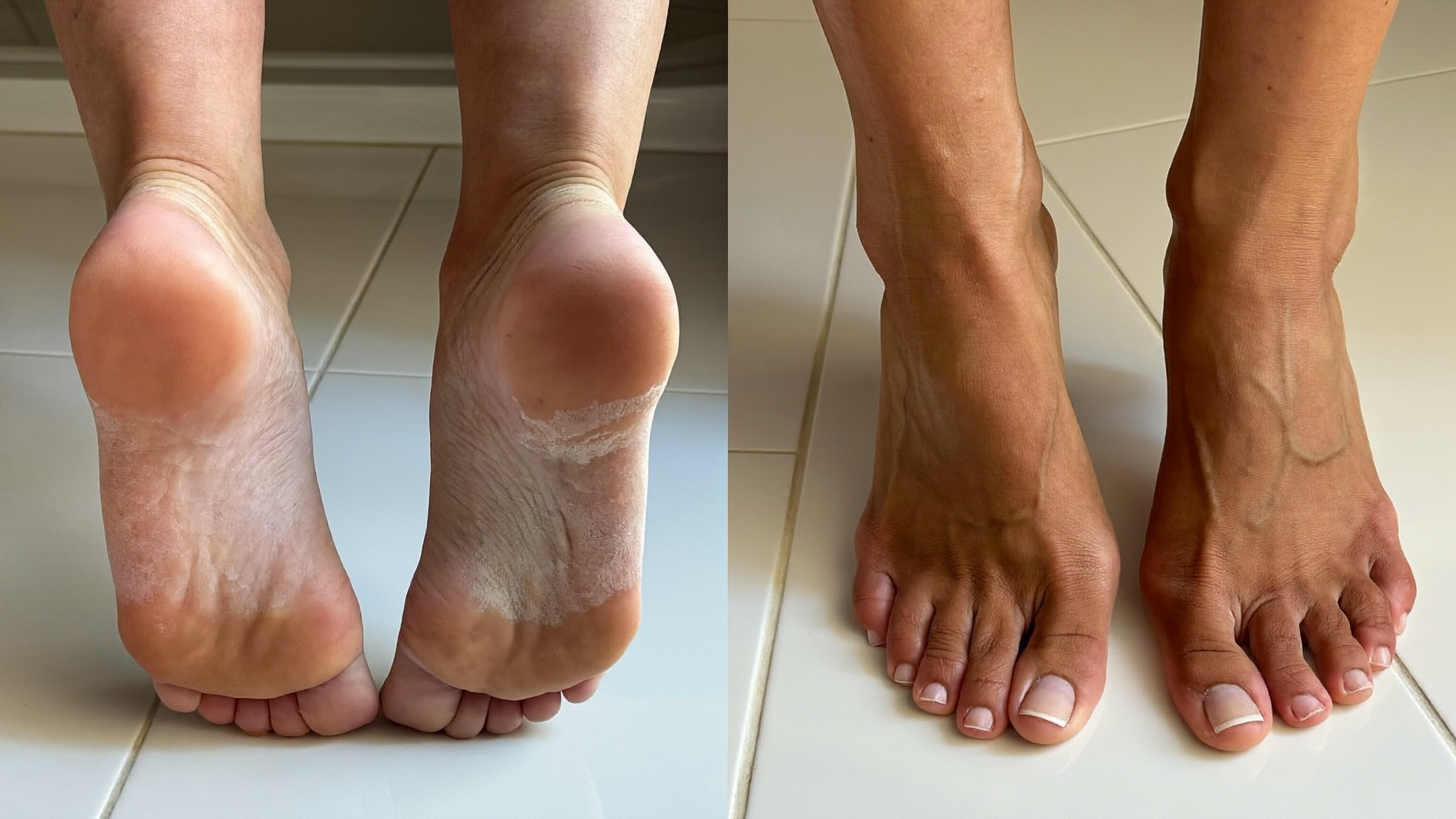
1. It's Not Dry Skin. It's a Low-Grade Fungal Infection That Looks Identical.
Dermatologists estimate that up to 78% of chronic "dry, cracked feet" cases in menopausal women are actually a misdiagnosed fungal condition called moccasin-type tinea pedis.
Unlike the athlete's foot you picture (red, blistering, between the toes), moccasin-type fungus presents as thick, rough, peeling skin across the entire sole and heel. No redness. No blistering. Minimal itching. It looks exactly like the hormonal dry skin your doctor told you to moisturize.
The only way to tell them apart is a skin scraping under a microscope. But most doctors never do that. They see a menopausal woman with dry feet and write the prescription they always write: moisturize more.
This single misdiagnosis is why nothing has worked. You've been treating a skin condition. The problem is an organism living in your skin.
2. Menopause Creates the Perfect Environment For This Specific Fungus
During menopause, estrogen decline triggers three specific changes on the feet that make fungal colonization almost inevitable:
1. Skin pH rises toward neutral. Healthy skin sits at 5.5 pH (slightly acidic), which naturally repels fungus. When estrogen drops, that acidity weakens. The feet, already the warmest and most enclosed part of your body, lose their primary chemical defense.
2. The lipid barrier thins. Estrogen maintains the skin's fatty protective layer. Without it, that barrier thins, especially on the feet where it was already thinnest. Fungal organisms that previously couldn't penetrate the surface now can.
3. Dead skin accumulates faster. Estrogen regulates how quickly skin cells turn over. When it drops, dead keratin builds up on the surface. That buildup is exactly what dermatophyte fungi feed on. Slower turnover means more food, sitting there longer, in a less acidic, more permeable environment.
Those three changes together don't just make your feet dry. They make your feet a fungal paradise.
3. HRT Fixes Your Skin Everywhere. Except Your Feet.
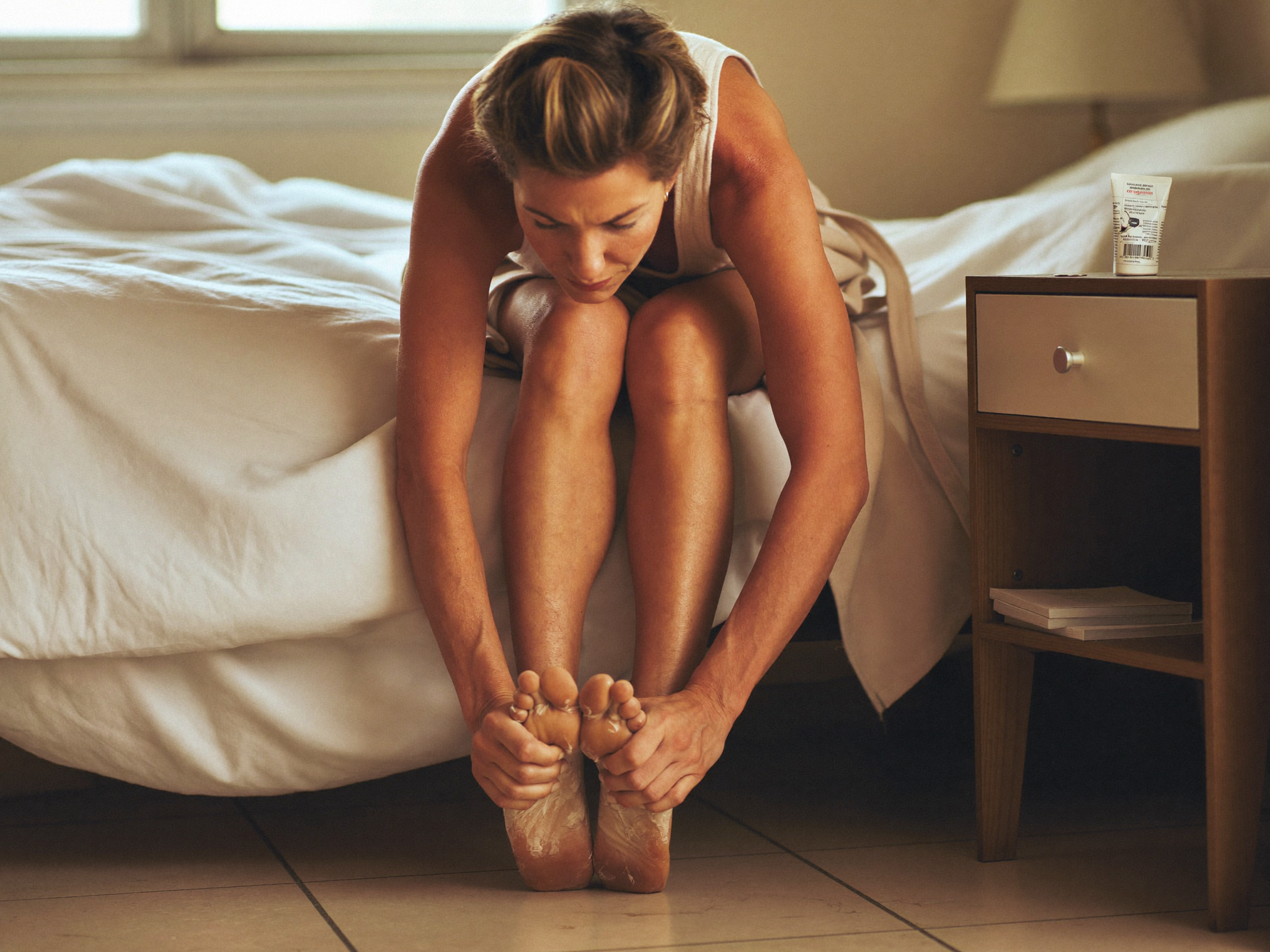
This is the detail that changes everything.
Women on HRT consistently report that their skin improved everywhere, forearms, shins, elbows, face, except their feet.
"I saw instant improvement in all of my skin and now the cracked heels are back."
"I am on HRT which helped my overall dry skin but man are my feet a mess."
If the feet were purely a hormone problem, HRT would fix them like it fixes everything else. It doesn't. Because by the time hormone therapy restores skin chemistry, the fungal colony on the feet is already established. It's built itself in. The improved pH and lipid function aren't enough to dislodge something that's been growing for months or years.
The menopause opened the door. Something else walked through it. And HRT closes the door behind it, but the thing is already inside.
That's why your arms are soft and your feet are still cracked. Different problems. One responds to hormones. The other doesn't.
4. Every Moisturizer You've Used Has Been Feeding It
This is the part that makes women sick when they hear it.
Every night you rubbed rich, thick cream into your feet, sealed them in cotton socks, and went to bed. You thought you were treating dryness. What you were actually doing was creating a warm, moist, sealed environment on top of a fungal colony and feeding it an overnight layer of the fatty acids it metabolizes for energy.
Shea butter. Petroleum-based overnight masks. Urea formulas. They all contain organic compounds dermatophyte fungi use as a carbon source. The socks sealed the heat and humidity in.
You weren't treating your feet. You were incubating them.
This is why moisturizer "works for three days then stops." It softens the surface temporarily while the colony underneath feeds, strengthens, and pushes the rough skin right back up.
The more aggressively you moisturize, the faster it returns.
What Women Over 45 Are Saying
Diane M., 54, Phoenix AZ ⭐⭐⭐⭐⭐
"I've been on HRT for two years and my skin looks amazing everywhere except my feet. My dermatologist told me to just keep moisturizing. I spent $400 on creams in one year. Three weeks with this soap and my heels are smoother than they've been since before menopause. I wish someone had told me I was treating the wrong thing years ago."
Karen L., 48, Nashville TN ⭐⭐⭐⭐⭐
"I thought menopause just gave some women bad feet. My mother had the same problem. I accepted it. Then I read about the fungal connection and tried this soap. Four weeks and my feet are almost back to normal. I wore sandals to brunch for the first time in three years. My friends thought I got a medical pedicure."
Janet W., 61, Denver CO ⭐⭐⭐⭐⭐
"My husband used to rub my feet every night. I stopped letting him two years ago because I was too embarrassed. Last Sunday I put my feet in his lap without thinking about it. He looked down and said 'what happened?' I just said I stopped treating the wrong thing. Best purchase I've made in ten years."
5. Filing and Peeling Your Feet Makes It Come Back Thicker
Every time you file your heels smooth with a pumice stone, you strip the top layer of dead skin and expose fresh keratinocytes directly to the fungal colony underneath. Fresh food, delivered right to the surface.
That's why the rough skin always comes back thicker after you file. The fungus has a fresh supply of exactly what it eats, and it responds by growing faster.
The chemical peels do the same thing on a larger scale. They strip the entire surface. Feet come out baby soft because everything on top is gone. But the fungal colony isn't on top. It lives in the deeper layers of the stratum corneum, anchored there by a protective structure called a biofilm.
Within three to four weeks after a peel, the colony recolonizes the fresh skin and pushes the rough patches right back up. Often worse than before.
6. Regular Antifungal Cream Can't Reach What's Actually Causing It
Once a dermatophyte fungus colonizes the skin, it secretes a polysaccharide matrix, a biological film, that encases the colony in a protective shell. This biofilm adheres to the deeper keratin structures and creates a physical barrier between the fungal organisms and anything you apply to the surface.
Topical antifungal creams sit on top of the skin. They penetrate the outermost layer. They kill the fungal cells they can reach, which is why they work for the first week or two. The surface clears. Symptoms ease.
But the biofilm underneath is intact. The cream can't penetrate it. The colony protected inside continues to grow. Within weeks it pushes new fungal cells up through the biofilm to the surface, recolonizes the cleared skin, and the symptoms return.
This is why antifungal cream "stops working." It never stopped working. It was never able to reach the part that matters.
7. 42.9% Tea Tree Oil Disrupts What Creams Can't Touch
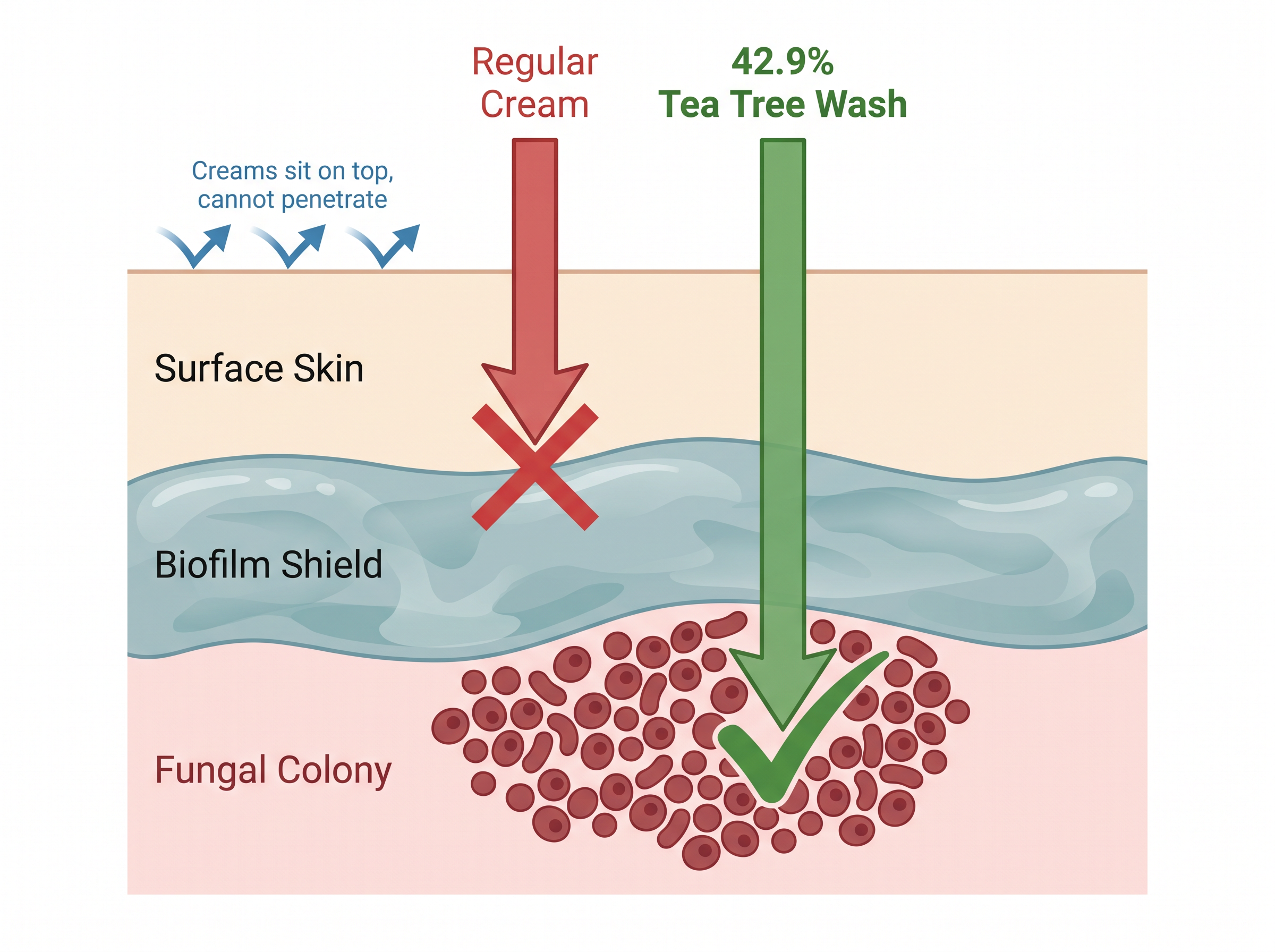
Terpinen-4-ol, the primary active compound in tea tree oil, has been clinically demonstrated to penetrate and disrupt fungal biofilm matrices at sufficient concentrations.
The key phrase: at sufficient concentrations.
Most tea tree products contain 1-2% tea tree oil. At that level, terpinen-4-ol reaches the skin at roughly 0.3 to 0.8 percent. Functionally nothing against a biofilm.
The studies showing actual biofilm disruption used concentrations where terpinen-4-ol reached 15-25% of the applied formula.
TerraFoot Antifungal Soap is formulated at 42.9% standardized tea tree oil. That concentration delivers terpinen-4-ol to the skin surface at roughly 18-20% of the applied formula during a 60-second wash. That's inside the range where clinical disruption of dermatophyte biofilm has been demonstrated.
1-2% tea tree is aromatherapy. 42.9% is a therapeutic concentration. The difference isn't incremental. It's a different order of magnitude.
8. It Works In Your Daily Shower. No Extra Steps.
The delivery format matters as much as the concentration.
A cream sits on top. A soak dilutes the active compounds. A wash does something neither of those can: the surfactant action lifts the biofilm mechanically while the terpinen-4-ol disrupts it chemically. The lather carries the active compound into the cracks, fissures, and interdigital spaces where the colony concentrates. The rinse clears the disrupted biofilm debris.
And it happens in the shower you already take. Every morning. 60 seconds. No cream to apply and wait for. No socks to sleep in. No mid-day reapplication. No new routine to remember.
Biofilm reconstitutes within 48 to 72 hours of disruption. That's why a twice-a-week treatment can't keep up. But a daily wash in your existing shower never gives the colony the window it needs to rebuild its shield.
The conditioning base, coconut oil, olive oil, glycerin, and sorbitol, repairs the skin the fungus damaged while the tea tree handles what caused the damage. Two things at once, in 60 seconds.
The Results Women Are Reporting
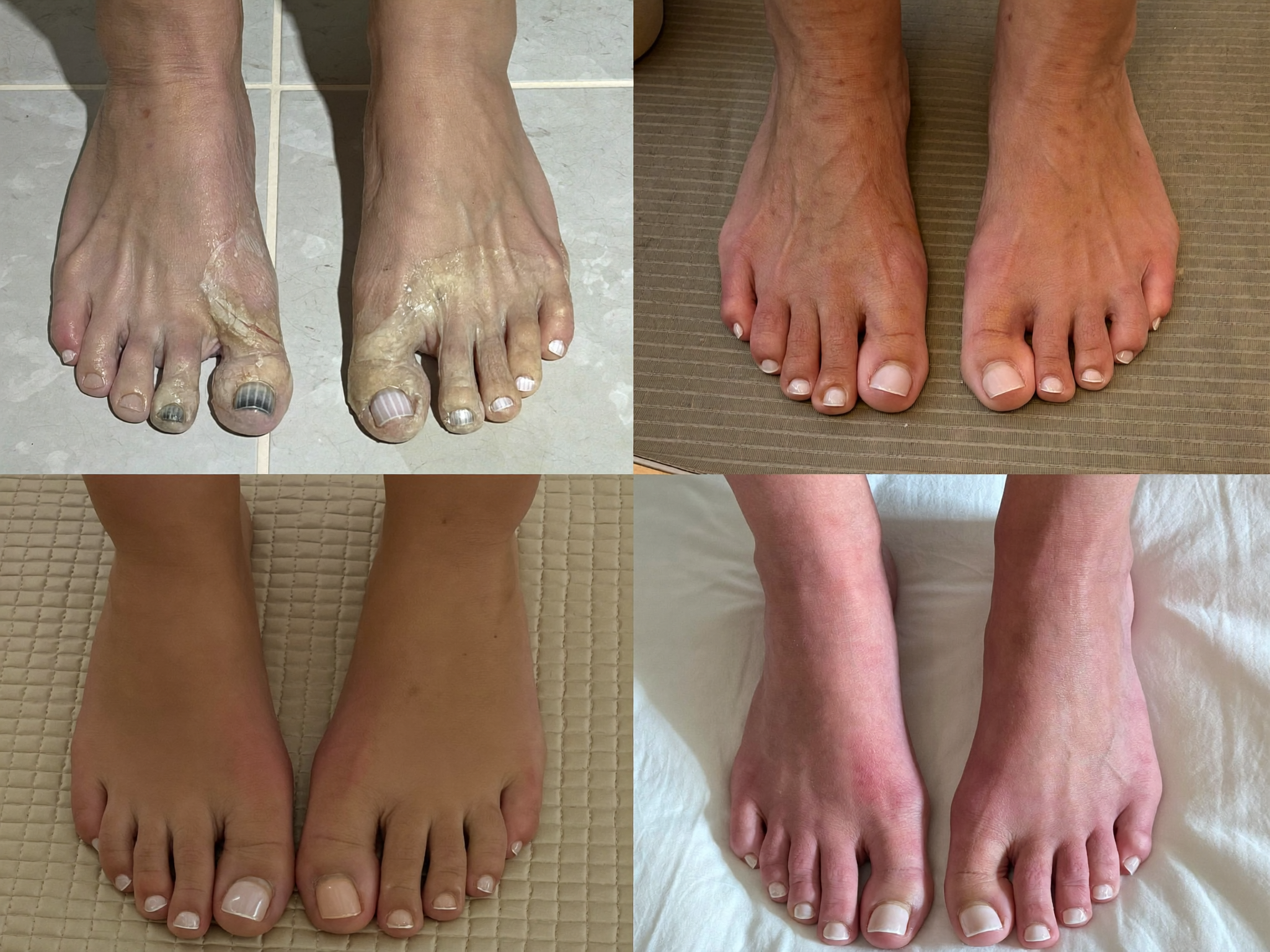
Days 4-7: Itching between the toes eases. That low-grade irritation you stopped noticing because it's been there so long? It stops. Sleep improves.
Week 2: Smell disappears. Peeling slows dramatically. Cracks begin closing from the edges inward. Skin starts feeling smoother instead of just temporarily softened.
Week 4: Visible smoothness returns to soles and heels. The thick scale that rebuilt after every filing and every peel? It doesn't rebuild. New skin grows in smooth instead of rough.
Week 6+: Women report wearing sandals again. Going back to pedicures. Letting their husbands touch their feet. Not thinking about their feet for the first time in years.
One bar lasts approximately 30 days. A full course to clear takes 4-6 weeks. Two bars covers it.
60-Day Money-Back Guarantee
TerraFoot offers a 60-day money-back guarantee, which is longer than any cream, peel, or moisturizer you've tried has ever lasted.
If your feet don't clear. If the peeling doesn't stop. If the cracks don't close. If you don't see a visible difference. Contact customer service for a full refund. No questions asked.
You risk absolutely nothing except 60 seconds a morning.
The product takes 4-6 weeks to fully clear. The guarantee gives you 60 days. That's enough time to know for certain whether this is the answer you've been looking for.
Important: If your feet are cracked deep enough to bleed, or you're diabetic, please see a doctor first. Feet aren't the place to gamble, and we mean that.
Two Paths
You're standing at a fork right now.
Path 1: Keep moisturizing. Keep filing. Keep buying the next cream that promises smooth heels and works for four days. Keep wearing socks in July. Keep skipping pedicures. Keep tucking your feet under the covers at night. Watch your daughter learn to hide her feet too, because she's watching you the way you watched your mother.
Path 2: Stop treating the wrong thing. Replace the lotion with a 60-second wash that actually reaches what's underneath. Track it for four weeks. See what happens when you fight the fungus instead of feeding it.
The menopause opened the door. Something else walked through it. And everything you've been putting on your feet has been feeding the thing that walked through.
Stop feeding it. Start washing it away.
Your future self, the one in sandals, will thank you.
Sandra P., 57, Austin TX ⭐⭐⭐⭐⭐
"Four years of cracked heels. My doctor said it was menopause. My gynecologist said moisturize more. I tried urea 40%, prescription creams, peels, everything. Three weeks with TerraFoot and my husband asked what happened to my feet. I told him I stopped treating the wrong thing. He cried."
Linda R., 52, Portland OR ⭐⭐⭐⭐⭐
"I was this close to accepting I'd never wear open shoes again. My mom had the same feet and she died never wearing sandals. Not once in her life. I started using this soap and within a month the cracks closed, the peeling stopped, and I went to a pedicure without flinching. My nail tech said 'whatever you're doing, keep doing it.'"
Dr. Patricia Vance, DPM, Board-Certified Podiatrist ⭐⭐⭐⭐⭐
"In 22 years of practice I've seen hundreds of menopausal women diagnosed with 'chronic dry skin' who actually have moccasin-type tinea pedis. The visual presentation is virtually identical. A daily antifungal wash at this concentration of tea tree oil is consistent with the biofilm-disruption approach supported by current research. I recommend it to patients who've failed topical moisturizers and antifungal creams."
Free shipping on BOGO 2+ orders. 60-Day Money-Back Guarantee. Individual results vary. This is a cosmetic cleansing bar and is not a substitute for professional medical care.

Get Your Feet Back. Try TerraFoot Risk-Free Today.
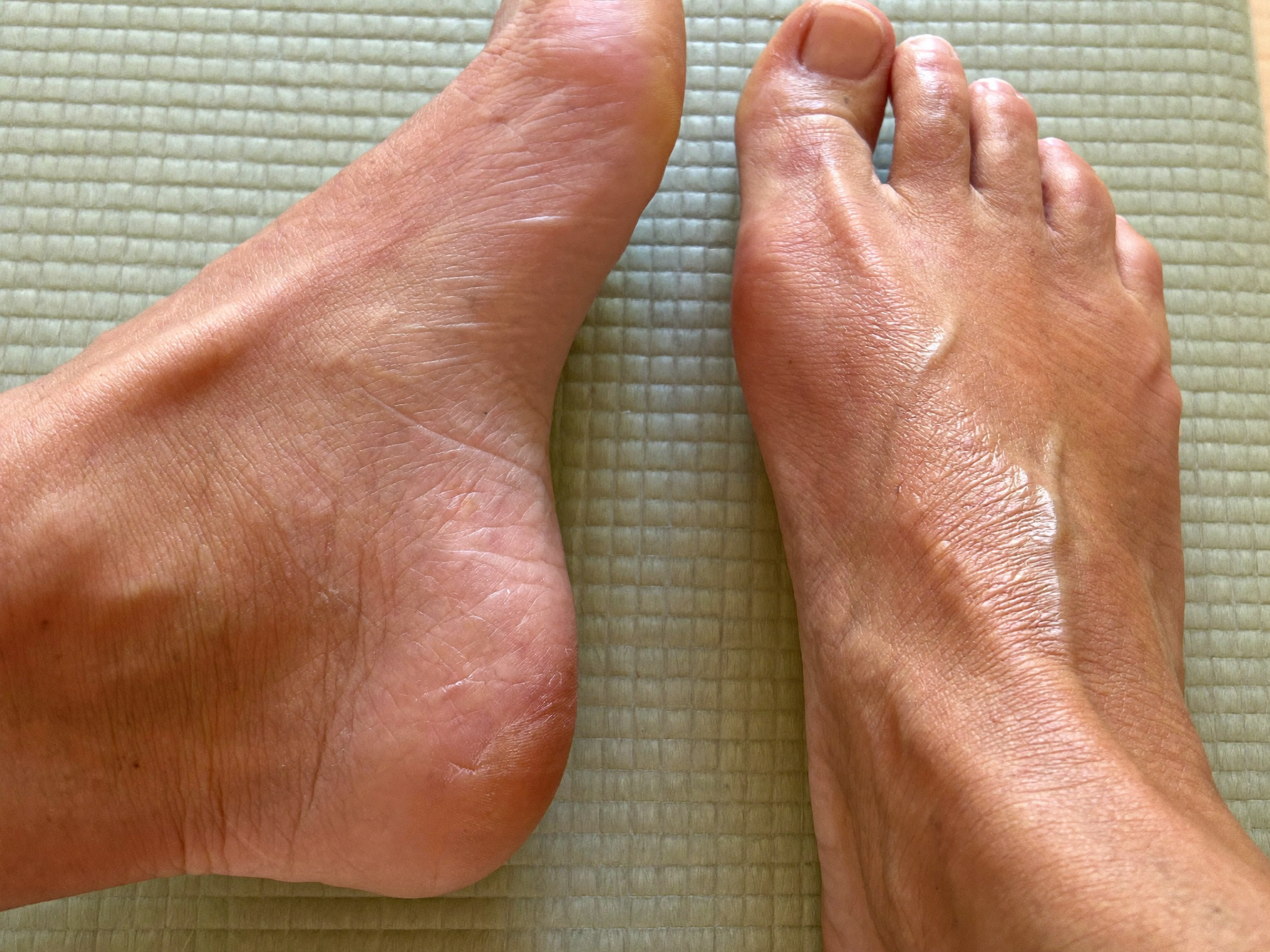
Every day you moisturize without addressing what's underneath is another day the colony feeds, the biofilm thickens, and the cycle digs deeper. The door menopause opened isn't closing on its own. What walked through it isn't leaving on its own. But it doesn't survive a daily wash built to reach it.
THIS IS AN ADVERTISEMENT AND NOT AN ACTUAL NEWS ARTICLE, BLOG, OR CONSUMER PROTECTION UPDATE. Individual results may vary. This is a cosmetic cleansing bar and is not a substitute for professional medical care.
This product is not intended to diagnose, treat, cure, or prevent any disease. The story presented above may contain fictional narrative elements. Results are not guaranteed and may vary from person to person. TerraFoot is a cosmetic cleansing bar.